
Why we will not give you a price per square metre for a renovation
The homepage calculator publishes a rate per square metre for finishing a shell. It refuses to publish one for renovating an existing property, and instead applies a multiplier to the fit-out subtotal. This article explains what those multipliers are, what they cannot possibly know, and why selecting renovation triggers a warning rather than a number you should rely on.
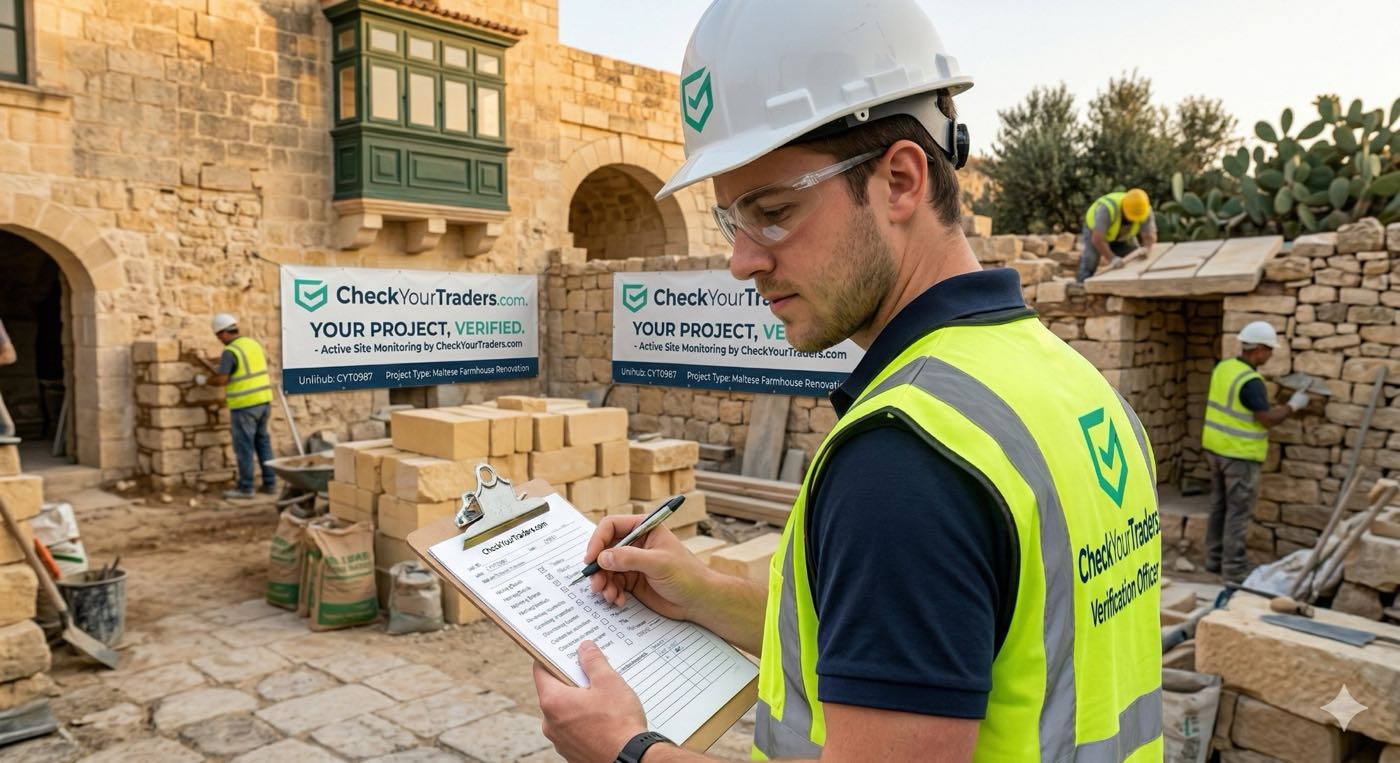
Everything else on this site is built on a published rate. You put in a floor area, you pick a finish level, and the calculator gives you a number for finishing a shell. That is the whole proposition, and it works because a shell is a knowable quantity. Renovation is the one place where we deliberately break it, and rather than quietly hiding that, it is worth explaining.
Why a shell can be priced per square metre and an existing building cannot
Property in Malta is normally sold in shell form. That is the default here in a way it is not in the UK or most of the EU, and it catches a lot of buyers out. But it has one enormous advantage for budgeting: a shell is a known starting point. The concrete frame is there, the blockwork is there, the apertures are usually not, and everything else is still to come. Two shells of the same size in the same block need very nearly the same work. That is why a rate per square metre means something.
An existing property is the opposite. Two flats on the same landing, built the same year by the same contractor, can differ by tens of thousands of euro depending on what a previous owner did to them in 1998 and whether anybody has looked behind the plaster since. There is no honest per-square-metre rate for that, because the square metres are not the variable. The history is.
What the multipliers actually are
The calculator handles renovation by applying a multiplier to the fit-out subtotal. It does not use a separate renovation rate, because there isn't one.
| Renovation type | Multiplier | Applied to |
|---|---|---|
| Light | 0.7 | the fit-out subtotal |
| Full | 1.35 | the fit-out subtotal |
| Heritage | 1.8 | the fit-out subtotal |
That is the complete published set. Read the second column as relative to finishing an equivalent shell, because that is what the fit-out subtotal represents.
The important structural point is in the third column. The multiplier is applied to the fit-out subtotal, not to the whole project, and the fit-out subtotal is the visible finishing work: the things you can point at during a viewing and say you would like changed. It is not a whole-building figure.
Light renovation is cheaper than a bare shell, and that is not a bargain
The light multiplier is 0.7. That is less than 1.0. A light renovation of an existing flat comes out cheaper on the calculator than finishing a shell of the same size, and people occasionally assume this is an error or a promotion.
It is neither. It is arithmetic about scope. In a light renovation you are keeping most of the property. The screeds are down, the plaster is on, the first-fix electrics and plumbing are in the walls, the apertures are hung, the sanitaryware is often serviceable. You are paying for a smaller quantity of work than a shell requires, so the number is smaller. The rate per unit of work has not changed at all.
The corollary is uncomfortable and worth stating plainly: 0.7 is only cheap for as long as everything you are keeping is actually fit to keep. The moment the plaster you were keeping turns out to be blown, or the first fix you were keeping turns out to be undersized, you are not doing a light renovation any more. You are doing a full one, plus the cost of the strip-out you had not budgeted for. The 0.7 does not degrade gracefully into 1.35. It jumps.
What the multiplier cannot know
This is the entire point of the article, so it gets its own list. A multiplier applied to a fit-out subtotal has no way of knowing about:
- structural movement, cracking that is live rather than historic, or a lintel that has been doing its job badly for thirty years
- failed or absent waterproofing, particularly on roofs and terraces, and the damp that has been quietly travelling down the wall from it
- timber that is rotten, undersized, or was never adequate
- services buried in walls that no longer comply with anything current and cannot be re-used
- materials from an era when things were used that are no longer used
- alterations a previous owner made without ever troubling the Planning Authority, which become your problem the moment you apply for anything
- a party wall, a shared roof or a common part where a condominium and your neighbours have a say in what happens next
- the plain cost of opening the building up to find out, and making good afterwards
None of that is in the fit-out subtotal. None of it is in the multiplier. An existing property's expensive surprises are behind plaster, and no coefficient can see through plaster.
Add to that the ordinary Maltese logistics that a rate card does not capture. Permits for anything beyond internal finishes go through the Planning Authority on the Planning Authority's timescale. Works in an apartment block are bound by the condominium's rules and, in practice, by the goodwill of the people living above and below the noise. And if the property is in Gozo, every skip out and every pallet in involves a ferry, which is a cost and a schedule constraint rather than a rounding error.
Why the calculator warns you
Select renovation and a warning appears next to the figure. It is there because the figure is genuinely less trustworthy than the shell figure sitting next to it in the same interface, and presenting the two with equal confidence would be dishonest design.
The multiplier is an order-of-magnitude tool. It is there so you can tell whether the conversation you are about to have is a €40,000 conversation or a €140,000 one, and so you know roughly what the finishing work costs before anybody starts telling you about the building. That is a real and useful thing. It is not a budget, and 1.35 is not a reliable way to budget a full renovation.
If you are reading this and feeling slightly less confident in the number you just generated, the page has worked.
What converts a multiplier into a budget
One thing: somebody opening the building up and reporting on what is in it.
A condition survey before you exchange, and a structural opinion where the fabric is in any doubt, is the step that turns a coefficient into a figure you can plan around. It is the least glamorous money you will spend on the project and the only money that reduces the size of the unknown. Buyers coming from the UK are often used to a survey being routine; here it is common to skip it, and shell purchases have half-trained people out of the habit because there is nothing yet to survey. On an existing property that habit is expensive.
Until you have that report, treat the calculator's renovation output as the floor of a range whose ceiling nobody knows yet — and hold a contingency you would genuinely be prepared to spend in full, because on an older Maltese property you may well spend it.
Common questions
- Why does the calculator give me a renovation figure at all if it is unreliable?
- Because a reader who selects renovation and sees nothing simply goes and finds a worse number elsewhere. The multiplier gives you an order of magnitude for the visible fit-out work — the same work the shell rate covers — so that you can tell whether you are in a €40,000 conversation or a €140,000 one. It is not a budget. The warning that appears alongside it exists because the figure omits everything that has to be discovered by opening the building up.
- Why is light renovation cheaper than finishing a bare shell?
- The light renovation multiplier is 0.7, applied to the fit-out subtotal, which is less than the 1.0 you would pay to finish an equivalent shell. That is not a discount. It reflects that in a light renovation most of the existing property is being kept: the screeds, the plaster, the first fix, the apertures and often the sanitaryware stay where they are. You are paying for a smaller quantity of work, not a cheaper rate for the same work.
- What would make my renovation land above the 1.35 full-renovation multiplier?
- Anything the multiplier cannot see. Structural movement, failed waterproofing, rotten or undersized timber, buried services that no longer comply, asbestos-era materials, previous unpermitted alterations, or a party wall shared with a neighbour who has their own opinion about it. None of these are visible when you view a property, and none of them are in the fit-out subtotal the multiplier is applied to.
- So what number should I actually budget with?
- One produced after somebody has opened up the building. A condition survey, and where the structure is in question a structural opinion, is what converts a multiplier into a budget. Until then, treat the calculator's renovation output as the floor of a range whose ceiling nobody yet knows, and hold a contingency you would be willing to spend in full.
What we could not establish
- The rate card establishes the three multiplier values but does not define the boundary between light, full and heritage renovation. Where a specific property sits between two of them is a judgement, not a lookup.
- The multipliers are applied to the fit-out subtotal only. The sources do not establish any allowance for structural repair, underpinning, roof replacement, damp remediation, asbestos-era materials or making good after opening up.
- Nobody publishes a credible per-square-metre renovation rate for Maltese property, ourselves included. Figures circulating in agents' particulars and buyer forums are not traceable to a published rate card.
- The sources establish nothing about Planning Authority permit requirements, scheduled-property constraints, condominium consent for works in apartment blocks, or the cost of shipping materials to Gozo. Those are real cost drivers and none of them are in the multiplier.
- The sources do not establish what a condition survey costs in Malta or who is qualified to carry one out.
Sources
- Turnkey.mt budget calculator rate card (js/main.js) — Turnkey.mt · read 2026-09-02
Drafted with Claude — claude-opus-5, then read, corrected and approved by Neil Bennett before publication. We do not publish anything a person has not read.
Want this costed properly?
The calculator gives you a budget in a minute. A survey gives you a fixed price.
Book a free survey